If you’ve ever worked at a bar, a liquor store, or any place that requires checking IDs, you already know how unpredictable the experience can be.
Some nights, the IDs people hand you are so obviously fake that you can’t help but smile. Other nights, someone hands you a card that looks perfect until you tilt it just right or feel something strange under your thumb. That tiny detail the way the card bends, the way the photo looks a little too “studio-perfect,” or the way the hologram doesn’t behave like it should is often all it takes to expose the truth.
Real ID checking isn’t about accusing people or making things harder. It’s about safety, compliance, and understanding how U.S. identification works. A proper fake ID check is far more than a quick glance or a barcode scan. It’s a layered process part instinct, part training, and part attention to small details that most people never think about.
Today, in this post, I’ll show you how professionals detect fake IDs in the United States, using techniques grounded in real-world experience.
What a “Fake ID Checker” Actually Means?
Most people think a fake ID checker as a magical machine or smartphone app that instantly says whether an ID is real. But the truth is a bit more practical and a lot more human.
A fake ID checker is not a device. It’s a method a combination of:
- visual inspection
- understanding of DMV standards
- texture and material recognition
- behavior reading
- barcode validation
- and sometimes, specialized scanning equipment
Ask any experienced bouncer, bartender, or retail worker, and they’ll tell you that no single tool can catch every fake. Instead, it’s the combination of multiple small checks done quickly and consistently that catches most counterfeit IDs.
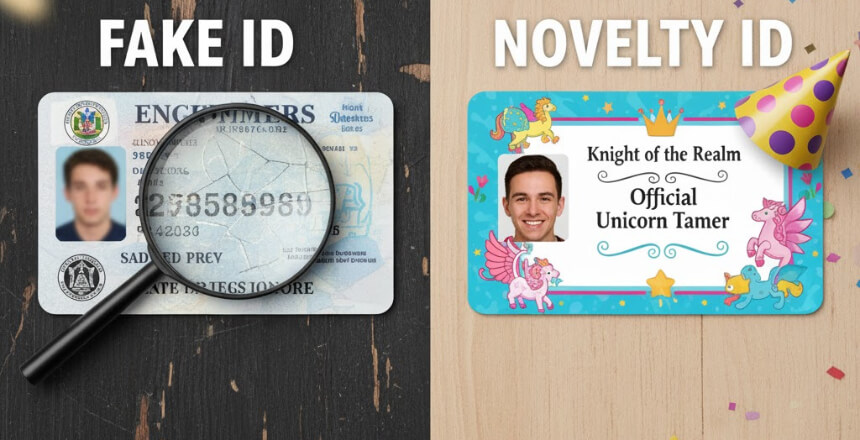
Must Read: Fake ID Vs Novelty ID – Know the Difference
How Experts Use Visual Checks to Spot Fake IDs
If you’ve handled enough real IDs, you develop a sixth sense. The moment a card touches your hand, something in your brain either relaxes or tightens. A real license has a certain firmness, a certain surface feel, and a layered construction that cheap fakes almost never replicate.
Texture: The Feel of a Real ID vs. a Fake
A real U.S. driver’s license is built with multiple layers of polycarbonate or advanced laminate materials. When you bend it, it doesn’t flop like a hotel key card, nor does it resist like a credit card. It has a controlled flexibility you can’t fake easily. You can feel raised text under your fingertips especially on newer REAL ID compliant cards.
On the other hand, fake IDs feel too smooth, too rubbery, strangely thin and unnaturally stiff. This is why some professionals say, “I know it’s fake before I ever look at the photo.”
Color and Layout: The Details That Fake IDs Don’t Get Right
Every U.S. state follows incredibly strict guidelines for layout, font weight, spacing, background gradients, and emblem placement. When you’ve seen enough real IDs from your state, these patterns imprint themselves in your mind.
Fake IDs tend to slip in subtle ways:
- the gradient is too sharp
- the state emblem is too dark or too bright
- the font size is slightly off
- spacing around the photo feels wrong
These are small things, but they matter. Real IDs look clean, consistent, and precise. Fakes often look like they’re “trying too hard” or missing some refinement.
Photo Alignment: A Common Giveaway
DMV photos look like DMV photos boring, flat, evenly lit, and a little lifeless. They don’t have shadows from ring lights or softbox glow. The background isn’t artistic or edited.
Fake IDs often use photos pulled from a phone gallery, which means:
- the lighting looks too warm
- the background is uneven
- shadows appear behind the head
- the person looks professionally photographed
Even the cropping can be off. DMV software places the face in a very specific position; counterfeiters rarely match this perfectly.
Security Features: The “Hidden Layers” Real U.S. IDs Use
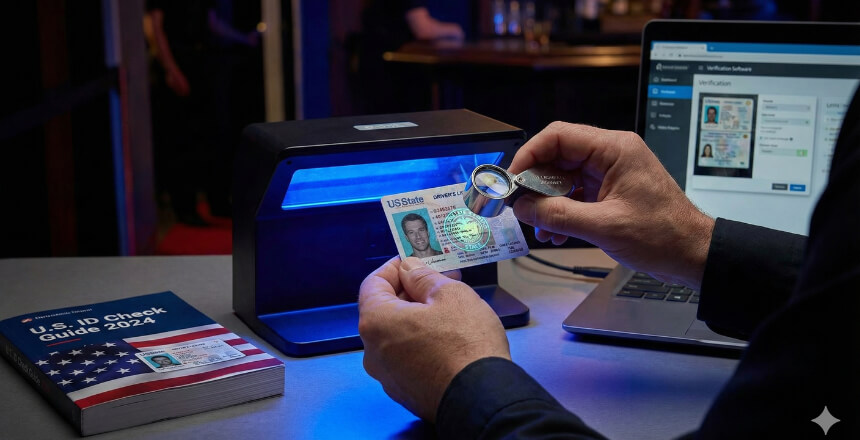
Security features are where most fakes collapse. U.S. driver’s licenses aren’t printed like normal cards they’re engineered using specialized material, UV-reactive ink, holographic overlays, laser engraving, and microprint. Replicating these features requires equipment that counterfeiters rarely have.
Holograms: The Movement That Gives Them Away
Real holograms are embedded into the card using optically variable devices. When tilted under light, they change color and depth in a very smooth, controlled way. You can almost feel the hologram reacting with the light.
Fake holograms often look static. They may reflect light, but they don’t “move.” Sometimes they look printed on top of the card instead of being fused into the surface. Once you’ve seen the real movement, the fake becomes obvious.
UV Ink: The Hidden Patterns Only Blacklight Reveals
Under UV light, real IDs come alive. State seals glow, patterns appear, and hidden details show up that you never see under normal lighting. These designs are intentional and follow precise rules set by each state.
Fake UV features often glow wrong:
- too bright
- too weak
- incorrect shape
- in the wrong parts of the card
Good counterfeiters try to replicate them, but very few succeed perfectly.
Microprinting: One of the Toughest Features to Copy
Microprinting is tiny text so tiny that you need a magnifier to see it clearly. On a real ID, microprint looks crisp. On a fake ID, it usually looks smudged, pixelated, or broken. This is because the printers used for fake IDs simply can’t generate that level of clarity.
The Real Role of Barcode and Magnetic Stripe Checking
Barcode scanning sounds high-tech, but most people misunderstand what it actually does. Retail scanners, bar scanners, and age-verification devices don’t connect to DMV systems. They aren’t checking a database. They’re checking formatting.
Here’s what a scanner does:
- reads the barcode
- pulls up encoded data
- matches it to what’s printed
If the scanner reads a different birthdate than the one printed, or the postal code doesn’t match the state’s formatting rules, the card becomes suspicious.
High-quality fake IDs sometimes pass barcode scans, but when scanned across multiple systems or checked against holograms or microprinting, they often fail the full verification process.
Why Online Fake ID Checkers Don’t Work
No website can connect to any official U.S. DMV database.
Privacy laws and federal regulations make that impossible.
So any “fake ID checker” website you see online can only:
- guess based on field formatting
- check if the barcode follows basic AAMVA rules
- compare visible template patterns
But it cannot confirm whether the ID was actually issued by a state.
No real authority offers public online validation, and any site claiming otherwise is misleading users.
Fake ID Checker Apps: Helpful but Limited
Apps are useful for quick checks, but they’re not magic. Most focus on the barcode:
Is the formatting correct?
Does the expiration date make sense?
Does the birthdate match the printed one?
But they cannot read microprinting, UV features, holograms, or lamination quality. They also cannot detect whether the person holding the ID looks like the photo.
Apps are tools not solutions.
How Bouncers Actually Check IDs (Expert Reality)
Spend any time talking to experienced bouncers and you’ll hear the same thing:
“I don’t look at the photo first. I feel the card first.”
A typical ID check takes only a few seconds, but a lot happens in that time:
Texture check feel the card’s flexibility and surface. If it’s wrong, the process is already halfway done.
- Light test – They tilt it to see how the hologram reacts. It either behaves correctly or it doesn’t.
- Data check – They glance at the DOB and visually cross-check the formatting and picture.
- Behavior check – They ask simple questions. The wrong hesitation exposes many fakes.
- Facial structure comparison – They don’t look at hair or style they look at the shape of the jaw, nose, and eyes. These things don’t change.
What looks like a “casual check” to others is actually a quick, practiced routine developed through experience.
Why Fake IDs Fail in Real Life
Even high-quality fakes show tiny flaws that accumulate:
- the laminate edge doesn’t fuse correctly
- the ghost image sits a millimeter too low
- the spacing around the portrait is slightly off
- the barcode formatting doesn’t match the issuing state
- the microprint looks blurry
- the UV pattern glows unevenly
None of these details alone always prove a fake, but together they paint a clear picture.
This is why human inspection catches things machines often miss.
Why Proper ID Checking Matters
In the U.S., checking IDs isn’t just a routine step it’s a safeguard. Allowing minors into age-restricted spaces creates real risks.
Businesses can lose their licenses or face large fines. But beyond business consequences, proper ID checks also prevent identity theft, impersonation, fraud, and unsafe situations for vulnerable individuals.
A good ID check protects the venue, the customers, and the people presenting the ID whether they’re genuine or not.